Why We Invested: Wayve


For most of the past decade, autonomous driving has been framed as a robotaxi race, in which each company builds its own software, maps one city at a time, and operates its own fleet. We think the larger opportunity sits with the automakers themselves. They built 96.4 million vehicles in 2025, and each of those vehicles is a candidate for autonomy, starting with hands-free driver assistance and moving toward driverless operation over time.
Few automakers can build that capability on their own. McKinsey estimates that developing and validating higher levels of autonomy will likely cost more than $1 billion, and that driver assistance and autonomous driving could generate $300 billion to $400 billion in the passenger car market by 2035. Valuations already reflect the size of the opportunity. Companies that run their own robotaxi fleets or build self-driving for their own cars are valued at anywhere from more than $100 billion to over $1 trillion, while Wayve, an independent supplier that licenses its technology to automakers, raised its Series D at $8.6 billion.
Our thesis is that every automaker will need autonomy and very few can build it themselves. The long-term winner will be the company supplying one central driving intelligence to them. We believe that company is Wayve, and the sections below explain why we invested.
The View: Driving Is an AI Problem
The first generation of autonomous vehicles was built on detailed pre-built maps, hand-coded driving rules, and separately engineered software modules. Every new city meant new mapping. Every new vehicle meant custom integration.
Wayve was founded in 2017 on the opposite bet: that self-driving is an AI problem. Its AI Driver is a single learned model that takes in what the car's sensors see and produces driving decisions. It learns from experience the way a human driver does, with no HD maps, hand-coded rules, or geofenced operating areas.
For years, that bet looked contrarian. Eclipse, which first backed Wayve in 2019, and Balderton, which backed it from its early days in a small Cambridge lab, have both said so publicly. In February 2026, Wayve described its Series D as marking industry convergence around the end-to-end approach it pioneered.
Our view. Map-and-rules autonomy scales like a services business: every new city and every new vehicle adds cost. Learned driving can scale like software. We think that difference decides who wins this market.
What stood out to us about co-founder and CEO Alex Kendall and his team was that they held this conviction for nearly a decade, until the industry came around to them. We look for that pattern in every founder we back: a clear view of where a market is going, held long enough for the evidence to catch up.
The Technology: One Driver, Any Vehicle, Any City
Wayve reports it became the first and only AV developer to drive zero-shot in more than 500 cities across Europe, North America, and Japan in a single year. Zero-shot means no city-specific fine-tuning before deployment. Its foundation model is trained on driving data from more than 70 countries and a wide range of vehicle platforms.
The same holds across vehicles. The AI Driver runs on each vehicle's own onboard compute and sensors. With Stellantis, Wayve brought up its first prototype, a Jeep Grand Cherokee, in under two months, then took Fiat 500e and Maserati Grecale development vehicles from integration to road testing in under four weeks each.
A Fiat city car, a Maserati SUV, and a Jeep Grand Cherokee now run the same core intelligence. One underlying model is designed to cover the full autonomy range, from supervised hands-free driving in consumer cars to driverless robotaxis. Wayve trains it on NVIDIA AI infrastructure hosted on Microsoft Azure. Automotive software integrations are usually measured in years. Wayve is measuring them in weeks. If a new city or a new vehicle no longer requires re-engineering, each market should be cheaper to serve than the last.
The Commercial Validation: Automakers, Platforms, and Investors
In 2026, Wayve moved from research to commercial deployment. Three of the world's largest automakers have put its AI Driver into production plans, and Uber is carrying riders in Wayve-powered vehicles in London.
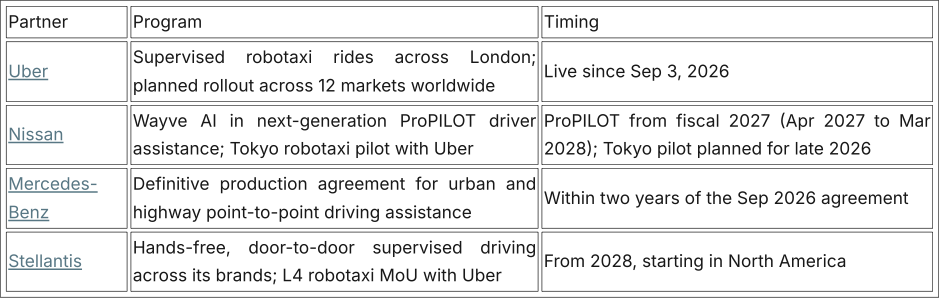
Uber (NYSE: UBER). Uber owns and operates the fleet while Wayve supplies the AI Driver, so Wayve scales robotaxi service without owning vehicles or depots. By launch day, more than 140,000 Londoners had opted in to be matched with a Wayve ride.
Nissan (TYO: 7201). Nissan plans to build Wayve's AI into its next-generation ProPILOT driver assistance, taking it into mass-market cars. Wayve has been testing in Japan since early 2025, and the Tokyo robotaxi pilot with Uber puts its AI Driver on some of the most demanding roads in the world.
Mercedes-Benz (XETRA: MBG). Before signing, Wayve integrated its AI Driver into Mercedes-Benz's own production hardware and MB.OS operating system, then demonstrated it in Stuttgart, London, and San Francisco. Mercedes-Benz calls the deal the first integration of the Wayve AI Driver in the premium segment.
Stellantis (NYSE: STLA). Stellantis is bringing Wayve across a portfolio that runs from Fiat to Maserati to Jeep. CEO Antonio Filosa has said the partnership could lower costs and shorten development time for hands-free driving. On October 23, Wayve, Stellantis, and NVIDIA announced a collaboration with the French government to advance autonomous vehicle deployment in France and across the EU.
Industry Leaders Invested. Wayve's $1.2 billion Series D, at an $8.6 billion post-money valuation, was led by Eclipse, Balderton, and SoftBank Vision Fund 2. Microsoft, NVIDIA, and Uber participated, and Mercedes-Benz, Nissan, and Stellantis invested alongside Ontario Teachers' Pension Plan, Baillie Gifford, Schroders Capital, and others. Including Uber's milestone-based commitment, Wayve secured $1.5 billion in total.
Wayve's largest commercial partners are also its shareholders. When the automakers and platforms with the most at stake in autonomy commit capital, engineering teams, and production programs to the same company, we weigh that more heavily than any benchmark.
The Moat: The Independent Layer
Wayve licenses its AI Driver directly to automakers and partners with platforms like Uber instead of owning fleets, an approach it expects will let it scale with lower capital intensity. Its CEO has argued that autonomy will scale through a shared platform that keeps improving as automakers and fleets adopt it, rather than through city-by-city robotaxi rollouts alone.
Every automaker faces a build-or-buy decision on autonomy, and most cannot build. Those that developed their own systems have largely kept them for their own vehicles and fleets.
That leaves room for very few independent suppliers, and the leader should compound. Each new partner adds driving data from new vehicles and roads, which improves the model every partner uses, which makes the next partner easier to win.
Mercedes-Benz, Nissan, and Stellantis compete for the same customers, yet all three invested in and licensed the same AI Driver. We read that as automakers treating Wayve as shared infrastructure, not a rival. Think of it as Intel Inside for autonomy: automakers compete on the vehicle, and the driving intelligence underneath is shared.
Risks We Weighed
Regulation. Autonomous driving is approved market by market, and timelines can slip. Wayve's London service launched with a trained safety driver on board, and fully driverless operation requires further approvals. Our thesis does not depend on fast driverless approvals: we expect supervised driver assistance to lead, with driverless service scaling gradually.
Competition. Autonomy is one of the most heavily funded areas in technology. Wayve competes with vertically integrated robotaxi operators, established driver-assistance suppliers, and fast-moving developers in China. We believe its edge lies in generalization and in serving many automakers at once.
Production cycles. Consumer revenue depends on automaker launch timelines, which can move. Programs with Nissan, Mercedes-Benz, and Stellantis spread that risk across several companies and regions.
Safety and public trust. A serious incident anywhere in the industry can affect regulation and public acceptance for every company in it. We view Wayve's staged approach, starting with supervised deployment and safety drivers, as the right one for this stage of the market.
The YXS Perspective: Our Investment Playbook, Executed
Readers of our published America 2026 Playbook will recognize the fit. In the Industrial Stack, we wrote that we expect autonomous driving to be among the earliest physical AI categories to reach broad adoption. We also said we focus on autonomy platforms that serve multiple manufacturers and operators. Wayve is that thesis in a single company.
It extends our work in the Cognitive Stack as well. Our investment in Liquid AI backed intelligence that runs on the device rather than in the datacenter. Wayve takes the same idea onto the road, and Mercedes-Benz now works with both of our portfolio companies: Liquid AI on in-car voice and language, Wayve on driving assistance.
Policy points in the same direction. U.S. Commerce rules bar Chinese and Russian automated-driving software from new vehicles starting with model year 2027. We expect that to support demand for trusted autonomy software from allied developers, and Stellantis plans to launch Wayve-powered hands-free driving in North America first.
Wayve also reflects the principles behind our past investments:
· Sourcing beyond consensus markets. Like Canva in Australia, Wayve was built outside the major U.S. venture hubs, in London.
· Conviction before consensus. Wayve held its end-to-end thesis for nearly a decade before the industry converged on it.
· Customers who are also investors. The automakers and platforms deploying Wayve's software also own part of the company.
· Capital efficiency. A licensing model lets Wayve grow through its partners' vehicles and fleets rather than its own balance sheet.
Our mandate is to back companies redefining how the world builds, powers, moves, and computes. Wayve sits where moving and computing meet, and we believe it is building the driving intelligence the next generation of vehicles will run on.
Sources and Announcements
· Wayve. Wayve secures $1.5B to deploy its global autonomy platform (Feb 25, 2026)
· Wayve. Wayve and Uber Launch First-Ever Autonomous Rides in the UK (Sep 3, 2026)
· Wayve. Wayve and Mercedes-Benz Partner to Bring the Wayve AI Driver to Future Mercedes-Benz Vehicles (Sep 22, 2026)
· Wayve. Stellantis and Wayve Demonstrate How AI Can Scale Across Vehicle Platforms (Oct 9,2026)
· Wayve. Wayve, Stellantis, and NVIDIA Collaborate to Advance Safe and Responsible Autonomous Vehicle Deployment Across France (Oct 23, 2026)
· Uber. Wayve and Uber Move a Step Closer to Autonomous Rides in London (Aug 5, 2026)
· Stellantis. Stellantis, Wayve, and Uber Partner to Scale Robotaxis Globally (Jun 17, 2026)
· Just Auto. Stellantis and Wayve technology partnership (May 22, 2026)
· Automotive News. Stellantis CEO says Wayve ADAS partnership will save money, development time (Oct 9, 2026)
· Automotive World. Nissan, Uber and Wayve join forces for Tokyo robotaxi pilot (Mar 12, 2026)
· GDN Online. Nissan, Uber and Wayve plan Tokyo robotaxi pilot (Mar 12, 2026)
· Liquid AI. Liquid AI and Mercedes-Benz Partner to Scale Embedded In-Car Intelligence (Apr 23, 2026)
· McKinsey & Company. Autonomous driving's future: Convenient and connected (Jan 6, 2023)
· OICA. Auto industry growth shifted east in 2025 amid global repositioning (Apr 23, 2026)
Important Disclosures. This article is provided by YXS Capital for informational purposes only. It references publicly available information, including company announcements, partner publications, press coverage, and third-party industry data from sources including Wayve, Uber, Mercedes-Benz, Stellantis, Nissan, McKinsey & Company, OICA, Reuters, and Automotive World. YXS Capital has not independently verified third-party information and makes no representation or warranty as to its accuracy or completeness. YXS Capital and/or its affiliates hold, or may hold, an interest in Wayve and may benefit from an increase in its value. Nothing herein constitutes an offer to sell, or a solicitation of an offer to buy, any security or investment product, and nothing herein constitutes investment, legal, tax, or accounting advice or a recommendation with respect to any investment or strategy. Any offer or solicitation with respect to any YXS Capital fund or investment vehicle will be made only pursuant to definitive offering documents, which will contain material information not included herein and which supersede this article inits entirety. This article contains statements of opinion, market views, and forward-looking statements, including projections and estimates regarding companies, markets, and technologies; such statements involve known and unknown risks and uncertainties, actual results may differ materially, and YXS Capital undertakes no obligation to update them. References to specific companies, including portfolio companies, are for illustrative purposes only, do not represent all investments made by YXS Capital, and should not be construed as an indication that any investment has been or will be profitable. Past performance is not indicative of future results. Investments in venture capital involve substantial risk, including the possible loss of the entire amount invested. Recipients should not rely on this article in making any investment decision and should consult their own advisors. Views expressed are those of YXS Capital as of the date of publication and are subject to change without notice.