Why We Invested: Mercury in 2019


Investment Summary
Overview
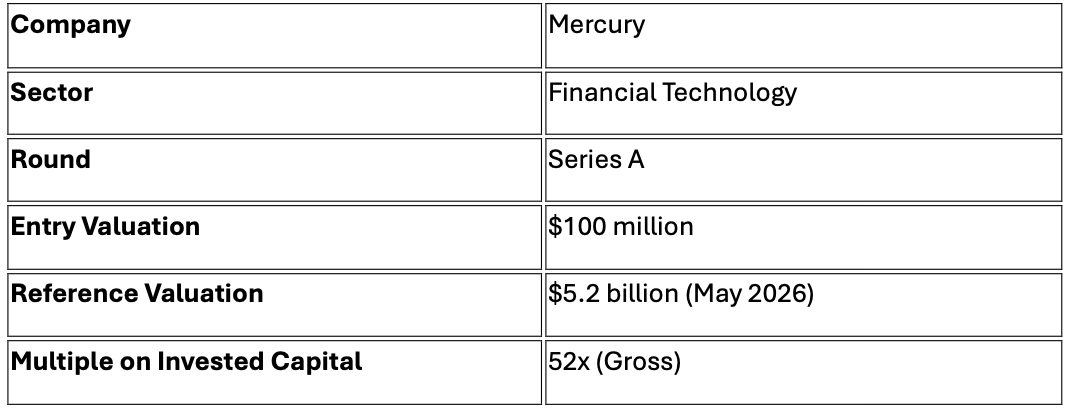
In 2019, YXS Capital invested in Mercury's Series A at a post-money valuation of approximately $100 million. Based on Mercury's $5.2 billion valuation in its May 2026 Series D, that position represents a 52x multiple on invested capital.
Our conviction in Mercury didn't start with a fintech thesis. It started with a problem we kept seeing across the companies in our network: startups needed banking built around how they operate, and the available options weren't meeting that need. Mercury was the company we saw solving it.
This case study covers why we invested in Mercury, the risks we weighed, and how the reasoning behind the decision continues to shape how we evaluate companies today.
Market Context
By 2018 and 2019, the companies in our ecosystem were raising capital faster, hiring across borders, and running more of their operations through software. Their banking hadn't kept pace. Traditional banks were largely built for established businesses, with onboarding, controls, and workflows that didn't fit early-stage companies. Newer fintech alternatives were emerging, but founders in our network consistently described friction in day-to-day workflows and uncertainty about whether those products could support them as they scaled.
We treated that feedback as a pattern rather than a set of isolated complaints. Banking designed around how startups operate had not yet been built.
The market was also highly concentrated. Silicon Valley Bank was the incumbent in startup banking, and it held about $175 billion in deposits before its 2023 collapse. A market that large, served by one dominant institution and few modern alternatives, was an opportunity for a company that could build a better product.
Founder Assessment
Mercury was founded in San Francisco in 2017 by Immad Akhund, Max Tagher, and Jason Zhang, with a clear mission: build banking that founders actually want to use.
Akhund had previously founded and sold Heyzap, a mobile advertising company, and had invested in many early-stage startups as an angel. He had experienced the problem directly as a founder and had seen it repeatedly across the companies he backed. In our experience, founders who have lived the problem they're solving make better product decisions earlier, and that is shown in how Mercury was built.
Akhund's credibility as a founder also helped Mercury build momentum with other founders ahead of broader investor awareness. That founder quality, clarity of mission, and early product resonance aligned directly with how we evaluate teams.
Building Conviction Through Product Usage
Our conviction came from using the product. Mercury was designed around founder workflows, stability, and clarity rather than retrofitted onto legacy banking infrastructure, and the difference was clear in daily use.
Early market response supported what we were seeing. Mercury launched publicly in April 2019, drew 1,500 signups in its first week, and grew about 40% per month afterward. Feedback from founders and operators in our network matched our own experience: the product fit how they ran their companies.
We also looked closely at the position Mercury was competing for. A startup's primary operating account is where investor capital lands, where payroll runs, and where every other financial tool connects. A company that wins that position has a durable foundation to build additional products on.
The Investment
Our allocation in the Series A came through relationships rather than competitive bidding. Three factors made it possible: our first hand experience with the product and informed comparison against alternatives, a long-standing relationship with a Bay Area fintech angel investor with visibility into the round, and referrals from founders and operators who knew us through product feedback rather than deal introductions.
We invested in Mercury's 2019 Series A, a $20 million round led by CRV with participation from Andreessen Horowitz, at a post-money valuation of approximately $100 million.
Our underwriting rested on four views:
· Startup banking was a large market served by products that hadn't been designed for it.
· Mercury's founders had the operating experience and product judgment to build the right solution.
· In banking, reliability and trust are the product, and Mercury was built with that as a priority.
· Winning a company's primary operating account would give Mercury a durable position from which to expand into adjacent financial products.
We also considered liquidity at entry. A company that became the primary banking relationship for a meaningful share of U.S. startups would have several potential paths to liquidity, including strategic interest from financial institutions and access to the public markets.
Key Risks Identified
Every investment carries risk, and we underwrote Mercury with several clearly in view.
Partner bank dependency. Mercury was not a bank, and its accounts were provided through partner banks. A problem at a partner could affect customers regardless of Mercury's own execution, so we weighed the team's approach to bank partnerships and compliance carefully. Mercury has since distributed deposits across multiple FDIC-insured institutions. It has also received conditional approval from the OCC for its own national bank charter, which would reduce that dependency overtime.
Competition. Startup banking was attracting well-funded competitors. We judged that product quality and trust among founders would matter more than capital in winning primary accounts, and that a product built around founder workflows would be difficult to replicate quickly.
Exposure to funding cycles. Mercury's customers are largely venture-backed companies, which ties its growth to the health of the startup ecosystem. We viewed the breadth of its customer base and its potential to expand into additional products as important offsets.
The Outcome
Against Mercury's May 2026 Series D valuation of $5.2 billion, our position represents a 52x multiple on invested capital.
Since our investment, Mercury has grown with discipline and kept its product reliable.
That reliability was tested in March 2023, when Silicon Valley Bank failed. In the five days after SVB's collapse, more than 8,700 new customers moved over $2 billion in deposits to Mercury, and 92% of those net new customers were still with Mercury six months later. For a company whose core product is trust, that retention mattered as much as the inflow.
In March 2025, Mercury raised a $300 million Series C at a $3.5 billion valuation, led by Sequoia Capital. In April 2026, it received conditional approval for a national bank charter. In May 2026, it raised a $200 million Series D at a $5.2 billion valuation, led by TCV with participation from Sequoia, Andreessen Horowitz, and Coatue.
At the time of the Series D, Mercury reported $650 million in annualized revenue and four consecutive years of profitability. Its CEO credited part of that growth to an AI-driven surge in new-business formation. It had more than 300,000 customers, including one in three U.S. startups. It has expanded into AI-driven financial tools, into payroll through its acquisition of Central, and into personal banking, and it plans to launch Mercury Command, a platform for financial work, later this year.

YXS Capital Investment Decision Framework
Problems before theses. We pay close attention to recurring problems across our portfolio and network. When the same operational friction appears across many companies, we treat it as a sourcing signal and look for the company solving it.
Founders who have lived the problem. We give significant weight to founders who have experienced the problem they're solving as operators. That experience tends to show up early in better product decisions.
Usage evidence over financial history. Mercury had launched publicly only months before its Series A. Our decision rested on direct use of the product, adoption data, and founder quality rather than a long financial track record. When usage evidence is strong and verifiable, we are prepared to invest early.
Trust as a product feature. In regulated categories such as financial services, reliability, compliance, and risk management are part of the product. We evaluate how a company approaches them as closely as we evaluate its growth, and we weigh its regulatory path as part of its long-term defensibility.
Concentrated incumbents. Markets dominated by a single provider can shift quickly when that provider stumbles. We look for companies positioned to capture share when that risk becomes visible, as Mercury did with early-stage startups after SVB's collapse.
Positions that grow with the customer. We look for products that become a customer's system of record and whose revenue grows as the customer grows. Mercury earns more as its customers raise capital, hold deposits, and spend. That keeps Mercury's incentives aligned with its customers' and compounds without proportional sales effort.
Risk underwritten at entry. We identify the specific risks in every investment before committing capital and track how the company addresses them over time. Investments are made with the downside understood, not only the upside.
Mercury began as a problem the founders in our network were living with. That remains one of the most reliable starting points we know for finding the companies worth backing.
Important Disclosures. This article is provided by YXS Capital for informational purposes only. It references publicly available information, including company announcements and press coverage from sources including CNBC, TechCrunch, Fortune, and Banking Dive. YXS Capital has not independently verified third-party information and makes no representation or warranty as to its accuracy or completeness. Mercury is a financial technology company, not a bank. The 52x figure represents a gross multiple calculated by reference to Mercury's post-money valuation in its May 2026 Series D relative to the post-money valuation of its 2019 Series A, in which YXS Capital invested. It is unrealized, is not based on a liquidity event, and does not reflect dilution from subsequent financings or any fees or expenses, which would reduce returns. Mercury is a private company, and its valuation is subject to change and may never be realized. This investment was selected for illustrative purposes, does not represent all investments made by YXS Capital, and should not be construed as an indication that any investment has been or will be profitable. Nothing herein constitutes an offer to sell, or a solicitation of an offer to buy, any security or investment product, or constitutes investment, legal, tax, or accounting advice. Any offer or solicitation with respect to any YXS Capital fund will be made only pursuant to definitive offering documents. Past performance is not indicative of future results. Investments in venture capital involve substantial risk, including the possible loss of the entire amount invested. Views expressed are those of YXS Capital as of the date of publication and are subject to change without notice.