The America 2026 Playbook: Architecting the Sovereign Operating System


Editor’s note: This update reviews developments since our January publication. The playbook describes the long-term direction we are investing behind, not a fixed timeline. We expect progress to vary by area and will continue to update it.
Key Takeaways
- Since January, federal policy has advanced in all four areas we track: public equity investment, AI adoption, advanced nuclear, and autonomy and robotics.
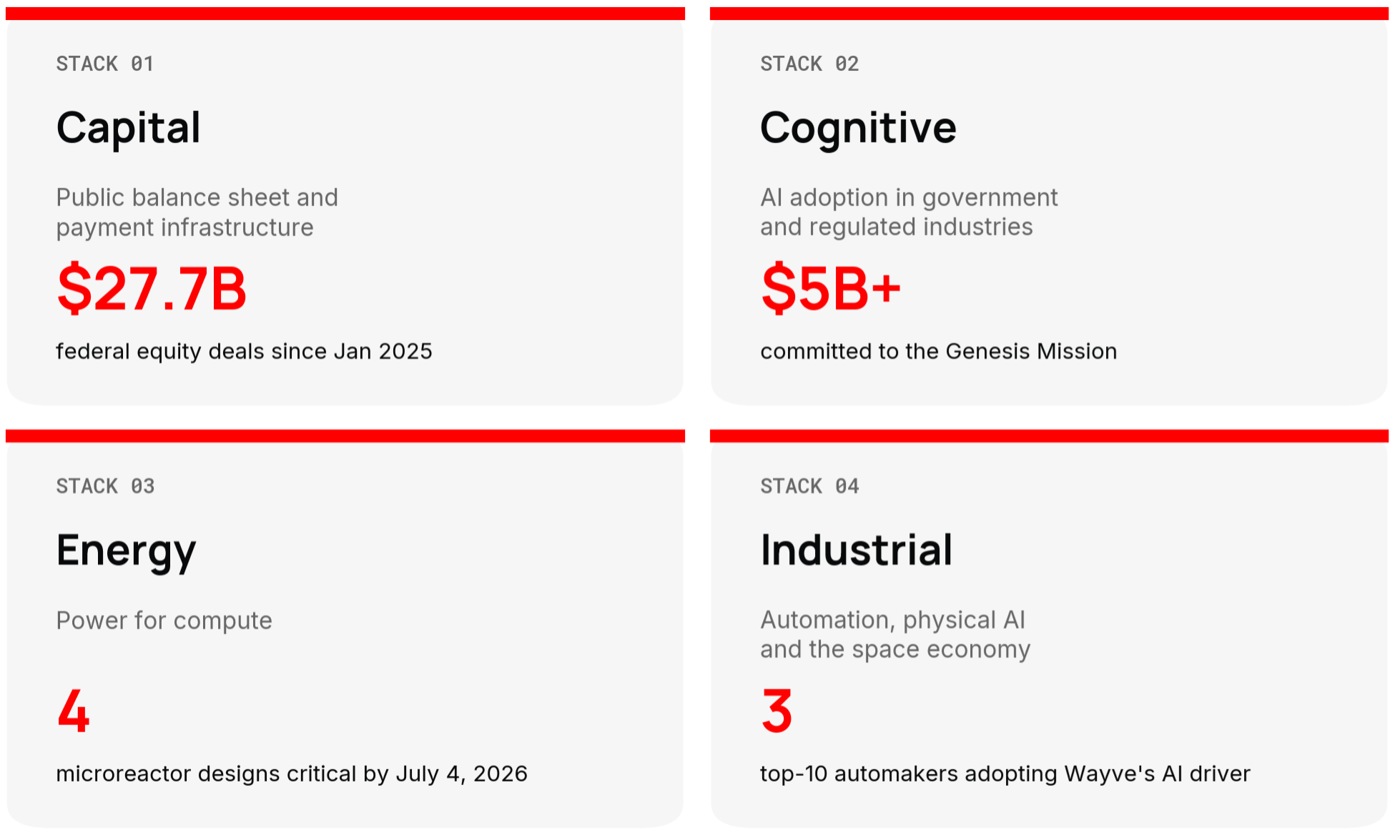
- Capital: about $28 billion across 39 federal equity deals, a federal stablecoin framework, and major banks preparing tokenized deposits.
- Cognitive & Energy: more than $5 billion committed to the Genesis Mission, and four advanced microreactor designs reached criticality by July 4.
- Industrial: physical AI is scaling first in autonomous vehicles, while orbital computing is early but drawing significant investment.
OVERVIEW
Four Stacks, Nine Months In
In January, we outlined four areas where we expect policy, capital and technology to shape U.S. economic competitiveness over the next two decades. The backdrop is a set of long-term pressures: federal debt above 100% of GDP, supply chains exposed to geopolitical risk, and rising costs for critical services. We believe technology will be a central part of how the U.S. responds, and federal policy increasingly reflects that view.
Since January, the administration has taken steps in each area, including equity investments in strategic companies, a national AI-for-science program, and an accelerated authorization pathway for advanced reactors. The sections below summarize what has changed and how it informs our investment focus.
STACK 01 / CAPITAL
The Capital Stack: Public Balance Sheet and Payment Infrastructure
Thesis
We believe the federal government can strengthen its long-term fiscal position by holding appreciating strategic assets alongside the debt it issues, in effect managing “USA Inc.” more like a balance sheet.
Recent developments
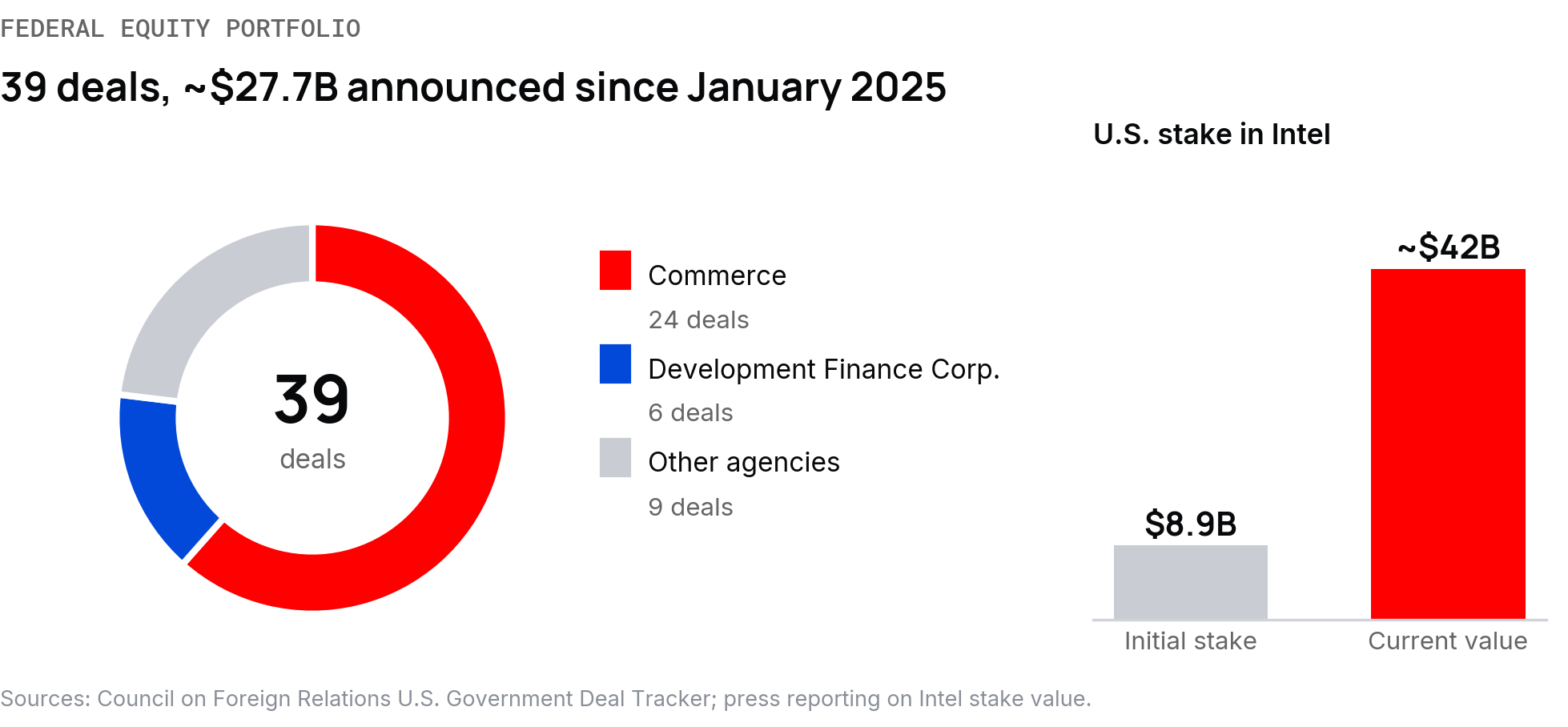
The February 2025 executive order directed planning for a U.S. Sovereign Wealth Fund. So far, that approach has taken the form of direct equity and quasi-equity investments. According to the Council on Foreign Relations’ deal tracker, the government has announced about $27.7 billion across 39 such deals since January 2025. The Department of Commerce accounts for 24, including a 10% stake in Intel, and the Development Finance Corporation has committed to six equity transactions in critical minerals, energy and infrastructure.
Several positions illustrate the approach:
- Intel. The $8.9 billion stake was assembled from previously awarded CHIPS Act grants and a separate Pentagon chip program. Its value has since grown to roughly $42 billion.
- MP Materials. The Pentagon holds a 15% stake and guarantees a floor price of $110 per kilogram for the company’s rare earth output.
- Semiconductors. In July, Commerce tied $874 million in chip-manufacturing incentives to equity stakes in seven companies, led by GlobalFoundries and Kepler.
National Economic Council Director Kevin Hassett has described the Intel position as a down payment on a sovereign wealth fund. The Strategic Bitcoin Reserve, established in March 2025, formalized the government’s bitcoin holdings as a reserve asset. Holdings are currently managed across several agencies. Consolidating them under a single governance framework, consistent with the sovereign wealth fund vision, would be a natural next step.
Payments and settlement
Cross-border dollar payments that move through correspondent banking networks can take days to settle. Programmable settlement systems, including regulated stablecoins and tokenized bank deposits, can settle in seconds and operate around the clock. We see this as a way to extend the dollar’s role in global commerce. Developments in 2026 include:
- GENIUS Act. Payment stablecoins now have a federal framework, with licensing, reserve and anti-money-laundering deadlines phasing in through 2026 and beyond. The stablecoin market has grown to about $317 billion.
- CLARITY Act. The market-structure bill advanced further than any prior effort, passing the House 294–134 in July 2025 and the Senate Banking Committee 15–9 in May 2026, before falling short of the 60 votes needed to advance on the Senate floor in September.
- SEC Innovation Exemption. The SEC has proposed an exemption, now open for public comment, that would allow tokenized stocks to trade on-chain.
- Tokenized deposits. Seventeen major institutions, including JPMorgan, Bank of America, Citi and Wells Fargo, announced that The Clearing House will clear and settle tokenized deposits on-chain, with a reported 2027 target.
YXS Perspective
We focus on infrastructure that connects existing banking systems to digital settlement: stablecoin issuance and compliance, tokenized treasuries and deposits, and the identity, custody and risk tools regulated institutions need. While market-structure legislation develops, we expect the strongest companies to be those building within the framework already in place.
STACK 02 / COGNITIVE
The Cognitive Stack: AI Adoption in Government and Regulated Industries
Thesis
We expect AI agents to take on a growing share of routine work in government and regulated industries, with people overseeing the results. That work ranges from document processing and compliance checks to spending review and fraud detection.
Recent developments
DOGE brought government efficiency to the center of the policy agenda. Federal AI programs are now building the tools to sustain those efforts over time:
- Genesis Mission. Launched by executive order in November 2025, the program integrates national laboratory supercomputers and secure datasets into a shared AI platform. In July, the White House announced more than $5 billion in commitments across 278 projects and over 15 agencies. NIST formally joined the effort in August.
- OneGov. GSA launched OneGov in April 2025 to buy software for the government as a single customer. About 3.4 million federal users can now access AI tools through the program, at agencies including Health and Human Services, Veterans Affairs, Transportation and State. GSA reports roughly $1.68 billion in savings.
Brookings finds that federal adoption has accelerated in recent years, with use concentrated so far among a handful of large agencies. We see two natural next phases: broader adoption across smaller agencies, and new applications in spending oversight and fraud prevention.
YXS Perspective
We invest in vertical AI applications built for regulated workflows in healthcare, tax and compliance. These are fields with heavy documentation requirements, where accuracy and auditability matter more than general capability. Our focus has also expanded beyond the data center:
On-device AI, where inference runs on the device itself, offers advantages in privacy, latency and cost, as in our investment in Liquid AI.
Physical AI, where models operate vehicles and machines in the real world.
STACK 03 / ENERGY
The Energy Stack: Power for Compute
Thesis
Electricity supply is becoming a practical constraint on AI deployment. The International Energy Agency projects that data center electricity demand will roughly double by 2030. We believe advanced nuclear will be an important long-term source of firm, carbon-free power for data centers and industry, alongside natural gas, existing plants, storage and grid upgrades.
Recent developments
Executive Order 14301, signed May 23, 2025, set up an expedited Department of Energy pathway for at least three privately funded test reactors to reach criticality by July 4, 2026. DOE selected 11 projects from 10 companies in August 2025. The program met its goal:
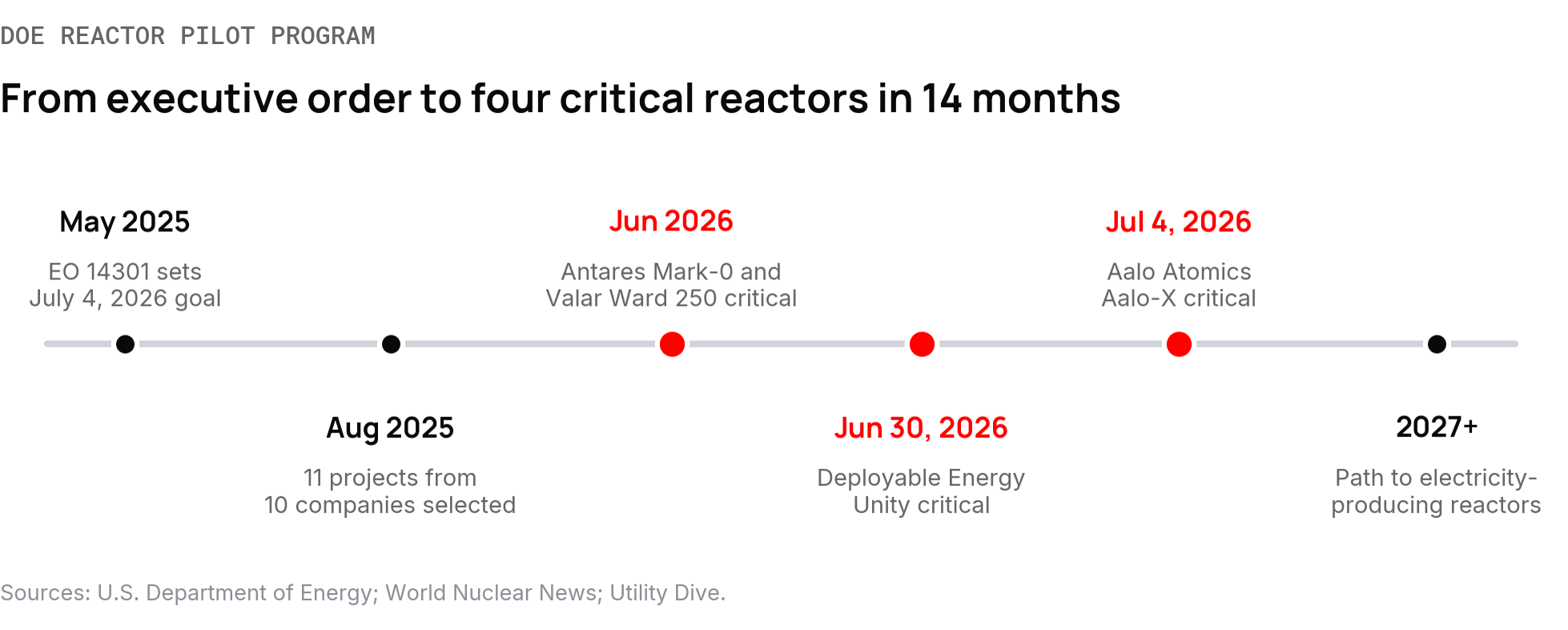
- Four designs reached criticality by the deadline: Aalo Atomics’ Aalo-X, Antares Nuclear’s Mark-0, Valar Atomics’ Ward 250 and Deployable Energy’s Unity.
- DOE said no other country had brought three distinct advanced microreactor designs to criticality in a single month.
- DOE says the zero-power tests establish a basis for later reactors to produce electricity from 2027.
The next phase, the Nuclear Energy Launch Pad, uses DOE authorization to certify and build first-of-a-kind demonstrations. Related approvals continued over the summer, including the safety analysis for Oklo’s isotope test reactor and the preliminary safety analysis for Last Energy’s PWR-5 pilot reactor at Texas A&M’s RELLIS campus.
In the near term, we expect natural gas and existing plants to carry much of the new demand, with advanced nuclear contributing a growing share over time.
YXS Perspective
We look at both sides of the equation:
Supply. Grid optimization, storage and advanced nuclear.
Demand. More efficient AI, including on-device inference that reduces load on data centers.
We view energy capacity and compute capacity as closely linked investment themes.
STACK 04 / INDUSTRIAL
The Industrial Stack: Automation, Physical AI and the Space Economy
Thesis
We believe automation and AI-driven robotics give the U.S. an opportunity to rebuild domestic manufacturing capacity at globally competitive costs, with American workers managing increasingly automated operations.
Automated manufacturing
“Dark factories,” or lights-out manufacturing, are facilities where most production runs without people on the floor. China has moved quickly:
- Zeekr operates a robotic plant built for 300,000 vehicles a year.
- Xiaomi’s $330 million Changping facility covers 81,000 square meters.
- CATL began what it describes as the world’s first large-scale robot deployment, in its Luoyang factory, and China’s State Grid has a $1 billion plan for 2026 to deploy humanoid robots for grid maintenance.
Industry experts note that no fully lights-out mass-production vehicle plant exists yet. One consultant expects the first in the U.S. within 15 years, and PwC identifies AI-powered robots on the factory floor as the next phase of automotive investment. U.S. capacity is also growing: Agility Robotics has opened the first U.S. factory for humanoid robots, designed to produce more than 10,000 units a year, and Amazon operates more than 750,000 robots across its logistics network.
Physical AI and autonomy
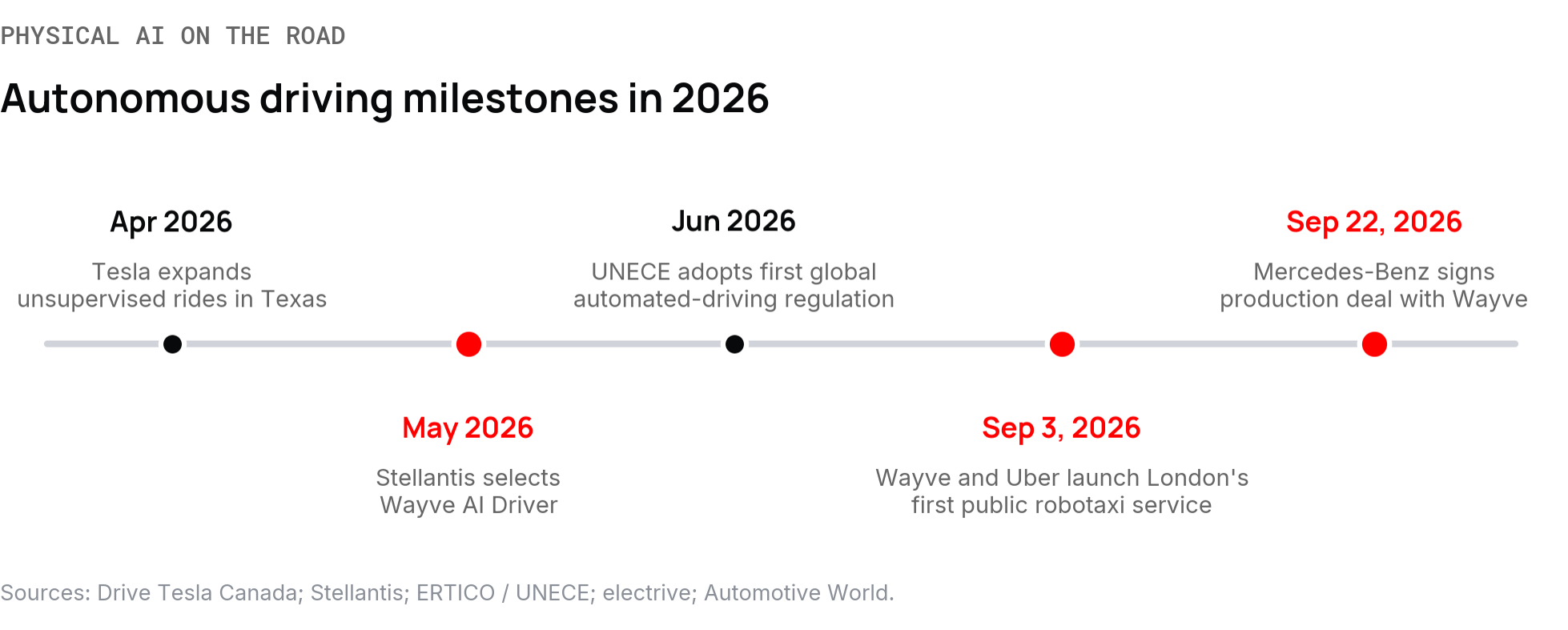
Autonomous driving is among the first applications of physical AI to reach commercial scale. In September, Wayve and Uber launched London’s first public robotaxi service, with a trained safety driver on board. Automakers are also moving: in the past nine months, three of the world’s top 10 carmakers have put Wayve’s AI driver into their production plans. In the U.S., Tesla operates unsupervised robotaxi service in Austin, Dallas and Houston.
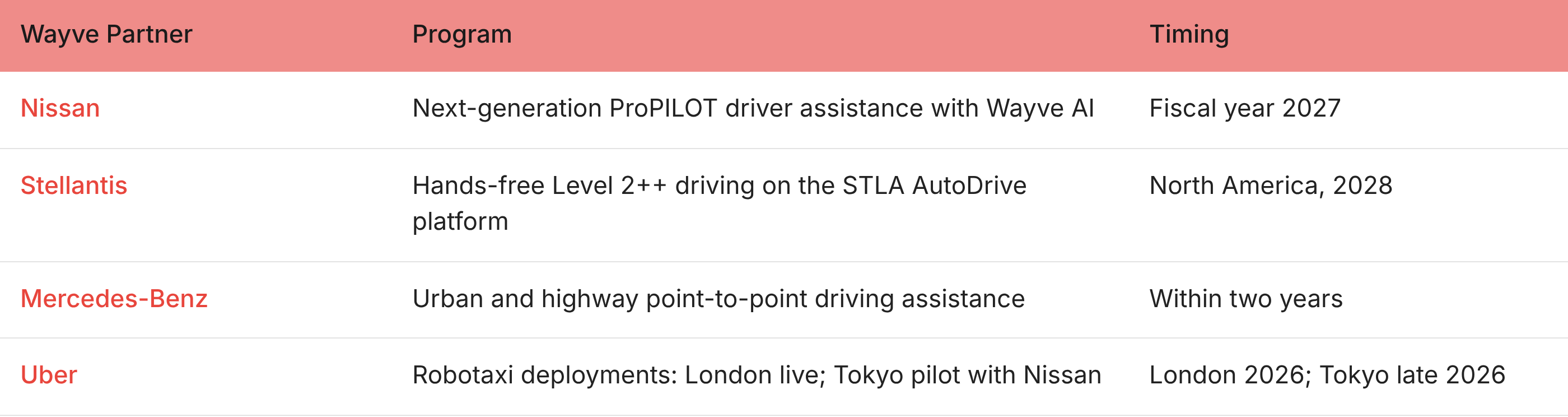
Sources: Automotive World (Nissan), Stellantis, Automotive World (Mercedes-Benz), electrive, Business Wire.
The regulatory framework is developing in parallel. In June, the UN Economic Commission for Europe adopted the first international regulation for automated driving systems, backed by Canada, China, the EU, Japan, the UK and the U.S. In the U.S., Commerce rules bar Chinese and Russian automated-driving software from new vehicles starting with model year 2027.
Robotics policy
The White House has been exploring a national robotics strategy, with Commerce Secretary Lutnick meeting leaders from Apptronik, Boston Dynamics and Tesla. Congress has introduced two bipartisan bills:
- The National Commission on Robotics Act, introduced in June, would establish an expert commission to guide policy.
- The American Security Robotics Act would bar federal procurement of ground robots and humanoids made by foreign adversaries.
China named robotics a strategic industry in its 2026–2030 five-year plan, and about 140 Chinese companies are developing humanoids.
Space economy
SpaceX completed the largest IPO on record in June, and much of the investor interest has centered on orbital computing. The orbital data center race now includes several major programs:
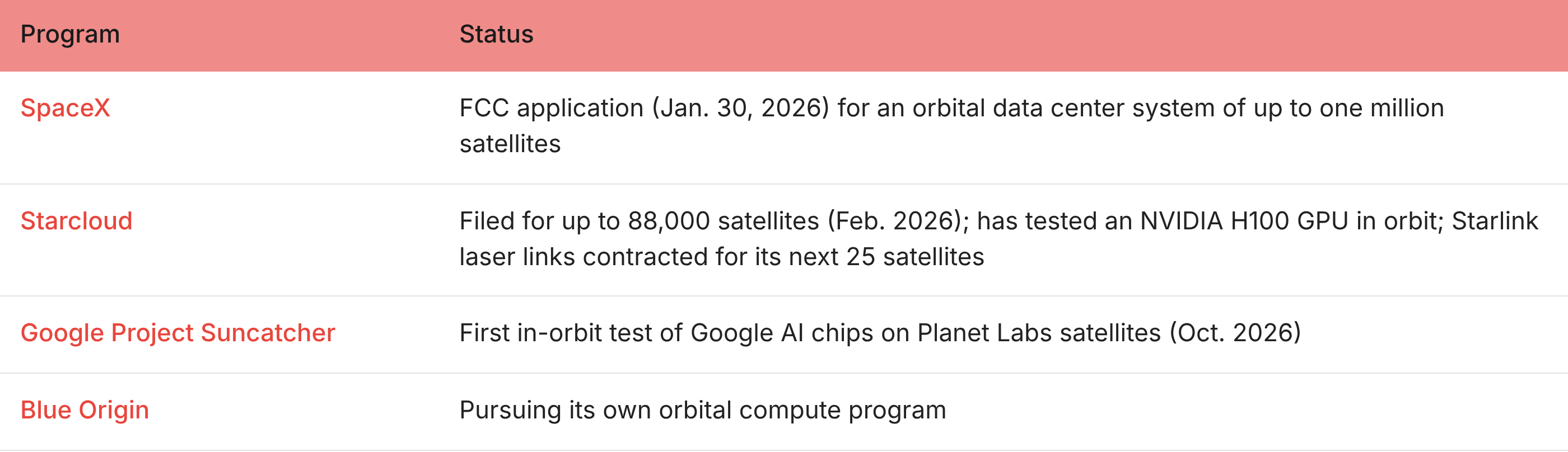
The commercial case is still early. SpaceX’s own pre-IPO filing noted that orbital data centers rely on unproven technologies and may not achieve commercial viability. The Golden Dome for America executive order adds a defense dimension to space infrastructure demand.
YXS Perspective
We focus on:
Software and AI that make automated production and robotics deployable at scale.
Autonomy platforms that serve multiple manufacturers and operators.
Space-based infrastructure: satellite intelligence, in-orbit computing and communications.
We expect autonomous driving to be among the earliest physical AI categories to reach broad adoption, and to inform how other forms of robotics are commercialized.
SCORECARD
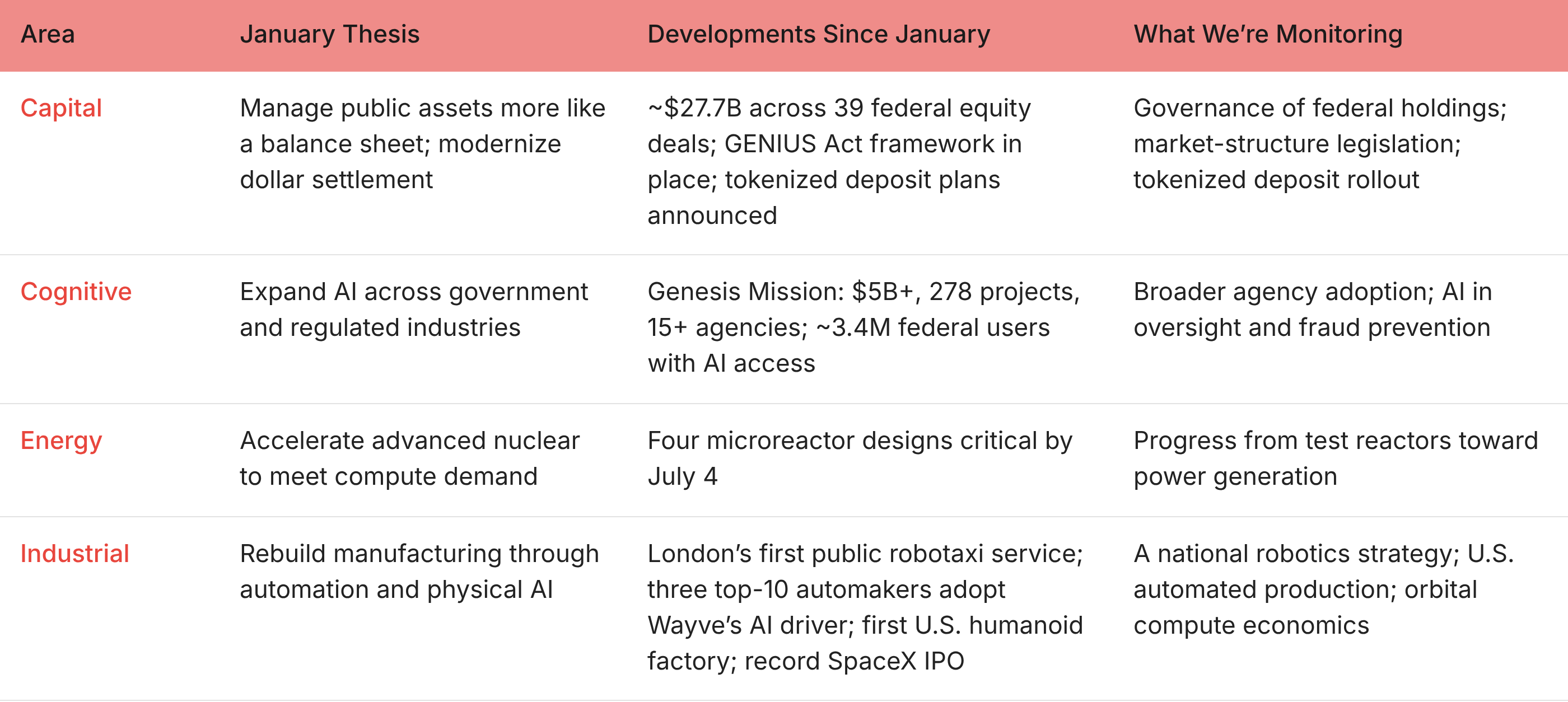
Nine Months In: Summary
CONCLUSION
Bringing It Together
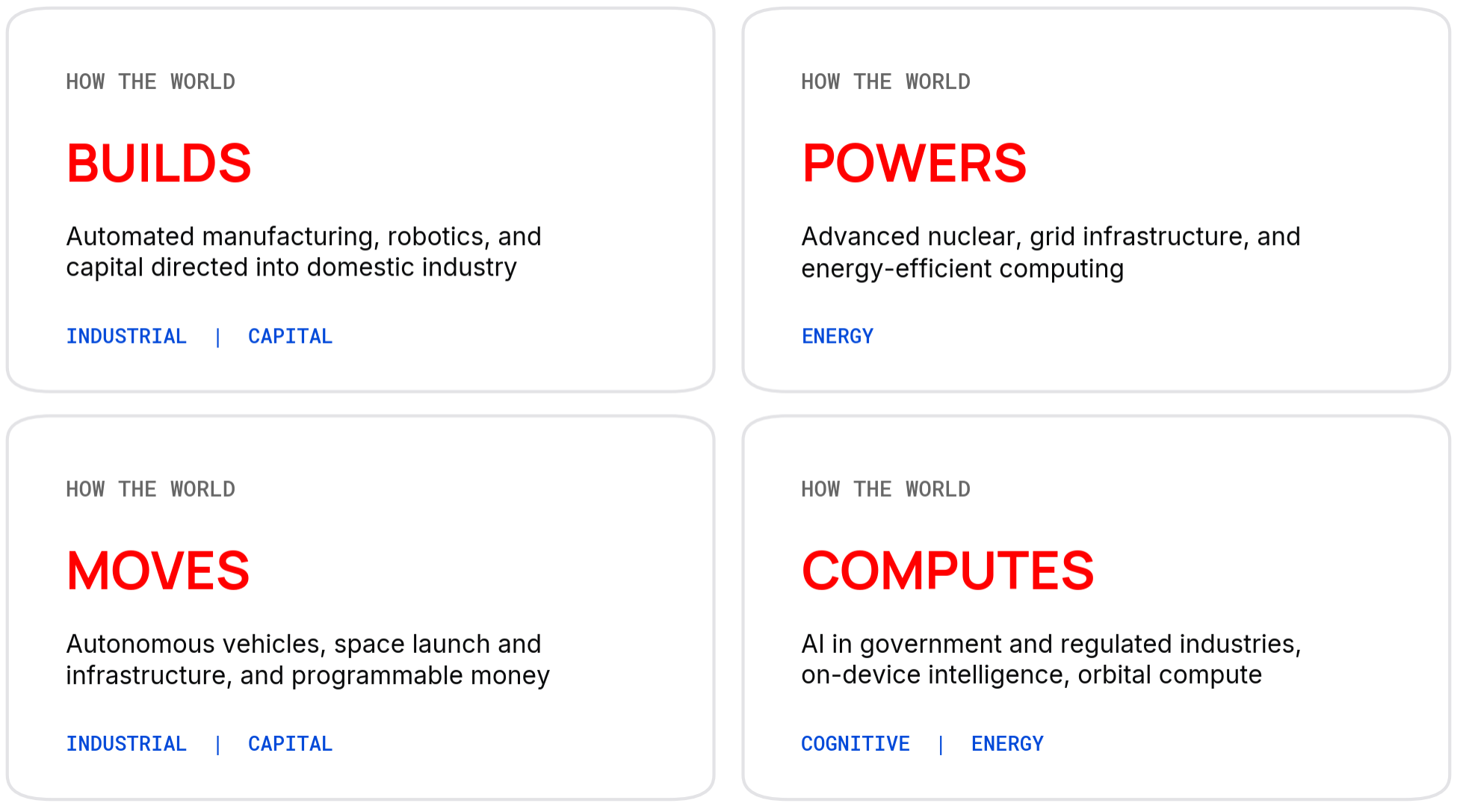
The four stacks are connected. AI deployment depends on power. Automated manufacturing and autonomous vehicles depend on AI. Modern payment infrastructure determines how capital moves to the companies building all of it. Progress in one area tends to support progress in the others, which is why we approach them as a single investment framework rather than separate sectors.
That framework maps directly to the technologies we back:
Sources and Announcements
Capital
- Council on Foreign Relations. Washington’s Growing Portfolio: Tracking U.S. Government Investments
- The Epoch Times. US Government Acquires Equity Stakes in 7 More Companies
- The Statesman. Why the US government could soon own stock in major AI firms
- CNBC. Crypto enters September with legislative policy gamble hanging by a thread
- Datawallet. CLARITY Act Explained: What It Is, Why It Failed & What’s Next
- Elliptic. SEC and CFTC push cryptoasset rulemaking in wake of failed CLARITY vote
- CoinDesk. The Clarity Act slipped to September. Banks are building anyway
Cognitive
- U.S. General Services Administration. GSA Expands OneGov AI Offerings
- Nextgov/FCW. Nearly 3.4M users across government can use AI through OneGov
- Cloud Security Alliance. NIST’s Genesis Mission and the AI Security Funding Gap
- Brookings. Assessing the state of AI adoption across the federal government
- YXS Capital. Why We Invested: Liquid AI
Energy
- U.S. Department of Energy. DOE Meets President Trump’s Goal, Delivers Third Advanced Reactor Criticality
- U.S. Department of Energy. EM Specialists Help DOE Achieve Criticality Milestones for Advanced Reactors
- World Nuclear News. Valar Atomics achieves criticality in DOE Reactor Pilot Program
- Utility Dive. DOE’s reactor pilot: A turning point for US nuclear energy?
- RealClearEnergy. Trump’s Reactor Pilot Program Is On Schedule
Industrial
- The Spokesman-Review. Fast-improving AI, robotics could make ‘dark’ auto factories a reality
- IMechE. Inside the rise of unmanned ‘dark factories’
- IEN. The Tech Enabling China’s ‘Dark Factories’
- Fast Company. Chinese humanoids are leaving American robots in the dust
- The Next Web. Wayve’s AI will reach Mercedes cars within two years, Kendall says
- Automotive World. Mercedes-Benz signs production deal for Wayve AI Driver
- Stellantis. Stellantis and Wayve Partner to Bring Hands-Free Door-to-Door Supervised Automated Driving at Scale
- Automotive World. Nissan, Uber and Wayve join forces for Tokyo robotaxi pilot
- Drive Tesla Canada. Tesla Cybercab production begins but unsupervised FSD remains limited
- electrive. Wayve and Uber launch autonomous rides in London
- Business Wire. Wayve, Uber and Nissan Announce Collaboration on Robotaxis
- ERTICO. UNECE adopts first-ever global rules allowing fully autonomous vehicles
- U.S. Bureau of Industry and Security. Commerce Finalizes Rule to Secure Connected Vehicle Supply Chains
- Humanoids Daily. White House Eyes ‘Robotics Executive Order’
- Robohub. Robotics roadmaps from around the world: United States
- U.S. House Science Committee. Hearing charter: Robots Made in America (April 2026)
- CNBC. SpaceX set to launch Google AI chips into orbit
- Introl. The Orbital Data Center Race: Every Major Player in 2026
- The Next Web. SpaceX’s IPO filing says its orbital data centres may never work
Important Disclosures
This article is provided by YXS Capital for informational purposes only and reflects the opinions of YXS Capital as of the date of publication. It references publicly available information from government agencies, companies, research organizations and press coverage, which YXS Capital has not independently verified. YXS Capital and/or its affiliates hold, or may hold, interests in companies referenced herein, including Liquid AI. This article contains forward-looking statements and market views that involve risks and uncertainties; actual results may differ materially, and YXS Capital undertakes no obligation to update them. Nothing herein constitutes an offer to sell, or a solicitation of an offer to buy, any security or investment product, or constitutes investment, legal, tax or accounting advice. Views are subject to change without notice.